
• Restorative Treatments for Grinders: Because bruxism can cause severe force on your teeth, it is common for patients to experience enamel “outer tooth structure” wear, cracks, broken or loose teeth or even tooth loss in advanced cases. For minor damage, tooth-wear facets can be easily restored and we can reconstruct the lost shape with composite “tooth colored” resin bonded fillings.
To restore teeth that are worn from excessive clenching, our office offers veneers and dental crowns as treatment options . Veneers are ideal for damaged anterior teeth. These thin shells add strength and beauty providing a beautiful smile, while covering flaws and imperfections. If you have a broken or severely damaged tooth, you may require a root canal, a dental crown, inlay/onlay or an overlay to restore the function and strength of your teeth.
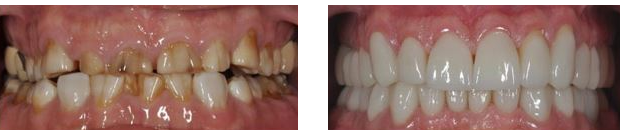
Our dentist generally prefers ceramic crowns over metal. Ceramic crowns are more aesthetically pleasing. There is a lower risk for the development of a black line at the gum line. Ceramic restorations can also be made thinner, which requires less tooth reduction, and they will not stain or change color. Ceramics are more bio-compatible than metal which may reduce gum recession. the newest ceramics can stand up to chronic tooth grinding . E-Max crowns offer the best cosmetic results. They are made of two layers: a strong and durable supporting layer called the coping and a lifelike top layer that matches the restoration to the natural teeth. We also offer zirconium crowns, which are considered among the strongest material available for dental crowns.
For tooth loss, options include dental implants, fixed bridges, or a partial removable denture. Each option has its cons and pros that should be explained at every case discussion.
Consciously stopping yourself from clenching can be difficult, which is why it’s crucial to at least take some precautions after the treatment. It is a fact that if you keep grinding or clenching your teeth, your new restorations will also suffer the consequences of bruxism. The forces you put on teeth when grinding or clenching exceed the resistance of any dental material. Accordingly, once your cosmetic and restorative treatments are complete, your dentist can design a night guard to protect them. The night guard should be worn during the night to protect your brand new teeth and smile make-over, or you can opt for muscle relaxant injections to weaken the jaws’s ability to clench and grind involuntarily.
To restore teeth that are worn from excessive clenching, our office offers veneers and dental crowns as treatment options . Veneers are ideal for damaged anterior teeth. These thin shells add strength and beauty providing a beautiful smile, while covering flaws and imperfections. If you have a broken or severely damaged tooth, you may require a root canal, a dental crown, inlay/onlay or an overlay to restore the function and strength of your teeth.
Our dentist generally prefers ceramic crowns over metal. Ceramic crowns are more aesthetically pleasing. There is a lower risk for the development of a black line at the gum line. Ceramic restorations can also be made thinner, which requires less tooth reduction, and they will not stain or change color. Ceramics are more bio-compatible than metal which may reduce gum recession. the newest ceramics can stand up to chronic tooth grinding . E-Max crowns offer the best cosmetic results. They are made of two layers: a strong and durable supporting layer called the coping and a lifelike top layer that matches the restoration to the natural teeth. We also offer zirconium crowns, which are considered among the strongest material available for dental crowns.
For tooth loss, options include dental implants, fixed bridges, or a partial removable denture. Each option has its cons and pros that should be explained at every case discussion.
Consciously stopping yourself from clenching can be difficult, which is why it’s crucial to at least take some precautions after the treatment. It is a fact that if you keep grinding or clenching your teeth, your new restorations will also suffer the consequences of bruxism. The forces you put on teeth when grinding or clenching exceed the resistance of any dental material. Accordingly, once your cosmetic and restorative treatments are complete, your dentist can design a night guard to protect them. The night guard should be worn during the night to protect your brand new teeth and smile make-over, or you can opt for muscle relaxant injections to weaken the jaws’s ability to clench and grind involuntarily.